
Searching the Montgomery County Court Docket
Route the request first, then type the name. Montgomery County splits its clerk duties. The District Clerk holds district civil, family, felony, and delinquent-tax files. The County Clerk handles County Courts at Law criminal and civil work. Probate and other assigned matters sit there too. Justice and municipal clerks each keep their own lower-court dockets. For county criminal, civil, probate, or calendar access, start at the County Clerk Odyssey Court Records Inquiry; for a district case, use the District Clerk’s official links.
A cause number is the most exact match. With only a name, enter the full name. Check the court, case style, and filing context before trusting a result as the right Montgomery County case. A failed web search is not the end of access. The clerk’s counter, phone line, and mail route remain open. So do the Records and Research unit and the statewide re:SearchTX layer.
- Identify the court from the citation, petition, notice, or prior order.
- Choose district, county, probate, JP, municipal, appellate, or federal access.
- Search by cause number when known, then use a name as a broader fallback.
- Read the latest event and setting, while checking for a reset or later order.
- Ask the correct clerk for a plain or certified document when the docket entry alone is not enough.
Montgomery County Odyssey Search Routes
The county’s public landing page names the service “Court Records Inquiry.” It also calls it “Odyssey Public Access Case Records.” Three choices await: Criminal Records, Civil & Probate Case Records, and Court Calendar. Those labels matter more than they seem. Criminal Records on the county route covers county-level matters. District felony access starts through the District Clerk route. The calendar shows settings only, not the full event history. The official Odyssey landing screen lays out that division of choices.
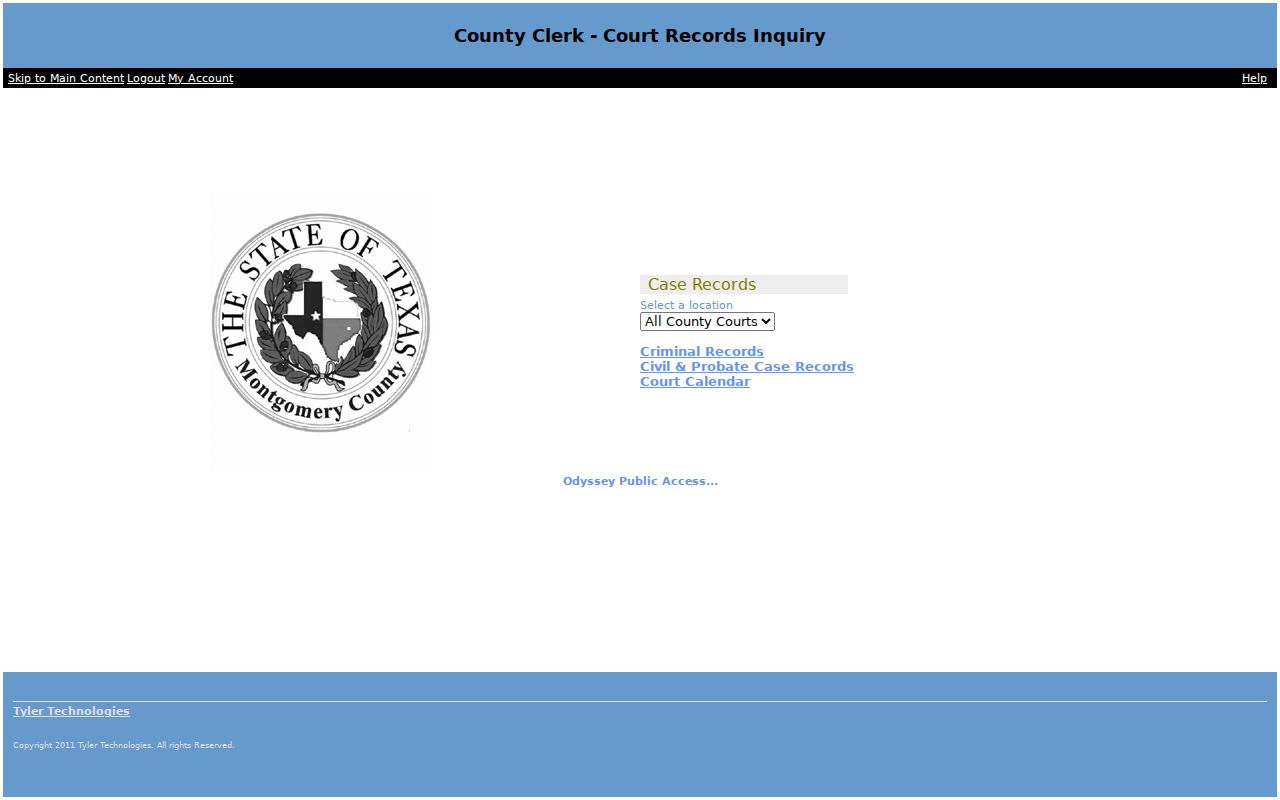
The screen helps you pick a record family before entering case details. District Odyssey sometimes redirects toward a login path. If that happens, keep your court and cause-number details and contact District Clerk Records and Research rather than assuming the Montgomery County docket is unavailable.
Inside a Montgomery County Court Docket
A docket is a chronology. It may list the cause number, case style, parties, attorneys, assigned court, filing events, motions, orders, settings, resets, disposition, and appeal activity. Locally, the word “docket” may wear other names. It can surface as Court Records Inquiry, Court Calendar, or a register of actions. Those are related views of the same case record. None of them promises that every filed document opens online.
| Cause number | The court-assigned identifier used for search and copy requests. |
|---|---|
| Case style | The caption naming the parties, or the State and accused in a criminal matter. |
| Filed event | A petition, motion, indictment, answer, notice, order, or other recorded action. |
| Setting | A date, court, and type of hearing, which may later be reset. |
| Disposition | The recorded result or closure event, whose exact meaning depends on the case. |
| Document access | An entry may exist even when its image is restricted or not posted. |
Need an official order or judgment? Record its exact title and request that document. A certified copy is a clerk-authenticated copy, distinct from a screen view or a plain copy.
Two Montgomery County Docket Clerks
In Montgomery County, “County Clerk” is not another name for “District Clerk.” The District Clerk serves the District Courts and maintains civil, family, felony, and delinquent-tax files. The County Clerk routes County Courts at Law and probate work. Send a request to the wrong office. You may get an empty search even though a case exists.
| Office | Main court records | Practical route |
|---|---|---|
| District Clerk | District felony, civil, family, delinquent tax | District Odyssey or Records and Research |
| County Clerk | County misdemeanor, county civil, probate | County Odyssey or clerk contact |
| JP or municipal clerk | Precinct or city cases | The named local court |
Figure out the court number before you order any record from Montgomery County. That one number tells the clerk which file system to search and which physical records to pull from the shelf.
Courts That Keep Dockets in Montgomery County
Montgomery County District Courts hear felonies and major civil or family matters. The roster includes the 9th District Court. It also lists the 221st, 284th, 359th, 410th, 418th, 435th, 457th, and 523rd District Courts. County Courts at Law handle county-level criminal and civil work as assigned. Probate Court No. 1 takes probate and guardianship matters. Five Justice of the Peace precincts keep justice-court dockets. Incorporated cities keep municipal cases.
| Court | Docket covers | Where to search |
|---|---|---|
| District Courts | Felony, district civil, family, tax | District Clerk and district Odyssey |
| County Courts at Law | Misdemeanor and assigned civil matters | County Clerk Odyssey |
| Probate Court No. 1 | Probate, estate, guardianship | County Clerk civil and probate route |
| JP Courts 1 through 5 | Small claims, eviction, Class C and traffic | Correct precinct clerk |
| Municipal courts | City ordinance, traffic, Class C | City court portal or clerk |
For current court contact details, the Texas OCA Directory Search is the best official check. Appeals from Montgomery County trial courts go to the Ninth Court of Appeals in Beaumont when that court has jurisdiction.
Montgomery County Docket Labels
Local labels can prevent a wrong turn. “Criminal Records” and “Civil & Probate Case Records” are search choices. “Court Calendar” focuses on settings. The state portal calls the event list a “register of actions.” “Official records,” though, often means something else. It usually points to the County Clerk’s recording and real-property index rather than a lawsuit docket.
- Reset
- A new date after an earlier setting moves.
- Continuance
- A formal request or order postponing a setting.
- Docket call
- A case-management session, not necessarily the trial.
- Disposition
- The outcome or recorded closing status.
- Certified copy
- A clerk-authenticated copy of a named record.
A missing PDF does not mean the docket event vanished. The attachment may simply be unavailable online, restricted, or something you must request from the clerk.
How to Find Court Dates and Settings
A future Montgomery County court date can appear in several places. The case register, Odyssey Court Calendar, a signed notice, or a court coordinator's record are the usual sources. Municipal courts can run their own citation and calendar routes. Specialty programs may publish program calendars, but those do not replace the underlying criminal docket.
Read the date together with its time, court, courtroom, judge, case number, and setting type. Then check for a newer reset, continuance, or cancellation. A signed order or current notice beats an old search result. If travel or a deadline rides on the entry, confirm it. Check with the responsible clerk or court coordinator. The full Montgomery County Court Dates resource explains the available calendar paths.
Local district rules tie arraignment to a standard discovery order and regulate continuance requests. A docket can list several linked settings. No single entry is the final trial date.
Montgomery County Specialty Docket Layers
Three specialty programs sit on top of Montgomery County criminal cases rather than replacing them. CARE Drug Court, Mental Health Treatment Court Services, and Veterans Treatment Court each add a treatment layer. The trial court keeps the underlying file. So a program's calendar or referral page will never give you the full criminal docket. It shows the program layer alone.
The 359th District Court hosts Veterans Treatment Court. It is a voluntary, phased program that meets on a second-and-fourth-Wednesday schedule. CARE works on substance abuse, addiction, and crime through a coordinated court and treatment model. Mental Health Court Services states a public-safety and treatment mission. Read the program page to understand a program event. Then read the court docket for filings, settings, orders, and disposition.
That split matters in Montgomery County. A program calendar tells you when participants meet. It does not expose the whole case file or every court event.
Public Access to Court Dockets
Texas has a Public Information Act. Yet adjudicative court records are not treated like ordinary executive-agency records. Many judicial records fall under Texas Rule of Judicial Administration 12 instead. Court rules, confidentiality laws, and sealing orders can also control case material. Whatever route you take, a request should identify an existing record, the court, the cause number, and a date or document name. Be specific on all four points.
Key access rules:
Texas Rule of Judicial Administration 12 provides an inspection and copying framework for judicial records that are not excluded.
Texas Judicial Branch Open Records Policy explains why adjudicative records do not follow ordinary public-information handling.
Texas Family Code Chapter 58 protects juvenile record information.
A case header can stay public while its documents are sealed, redacted, or withheld. The District Clerk's sealed-record form has a judge-authorization section. Filing it does not guarantee access. A stated reason cannot replace the court decision the form requires.
Montgomery County Copies and Fees
District Clerk Records and Research handles many district-file requests once a docket entry is not enough. The official form asks for plenty: cause number, court, case style, the exact document, copy count, certification choice, requestor details, return method, and payment. Supplying all of those fields up front can spare you an added name search or an unknown-cause search.
| Service | Published amount |
|---|---|
| Plain district record copy | $1 per page |
| Certified district copy | $1 per page plus $5 per document certification |
| Name search | $5 per name per ten-year period |
| Unknown-cause research on copy form | $5 |
| CD, FTP, or email delivery request | $9.35 per request |
Timing is stated in two places. The copy form estimates up to three business days from receipt. The Records and Research page adds a broader caveat. It allows ten business days for a response and states an office goal of four to five business days. Those figures cover different request contexts, and none is a guaranteed completion date.
Docket Records at the Clerk's Office
The District Clerk's main public office covers files from the 1900s to the present in the listed district categories. The Records and Research route does too. Send requests through the official form or office channels. One rule is firm: no fax requests will be filed. Clerk staff may explain access mechanics, but they cannot choose a legal strategy for you.
Montgomery County District Clerk
301 N. Main St., Suite 103
Conroe, TX 77301
Mail: P.O. Box 2985, Conroe, TX 77305
936-539-7855
The County Clerk runs a separate main office and annex network. Check the court named in the case header before sending anything. County-level requests should not default to the District Clerk.
State and Federal Docket Paths
re:SearchTX is the statewide layer. OCA says it can show parties, attorneys, case events, and documents where available. It does not promise that every Montgomery County document is present. County Odyssey and the clerk's own service remain the local fallback.
A trial-court appeal is searched through the Ninth Court of Appeals and the Texas appellate search. Use the trial county and trial cause number when possible. Appellate data refreshes nightly, so treat it as close to current rather than real time. Federal cases work differently. Montgomery County sits in the Houston Division of the Southern District of Texas. Those files live in PACER or the federal courthouse, not county Odyssey.
eFileTexas is distinct as well. It is the statewide filing engine for lawyers and parties where electronic filing applies. It is not a public Montgomery County court docket viewer.
Montgomery County Court Dockets by City
The five city pages follow the incorporated-place ranking in the official 2020 Census file. The Woodlands is left out because it is a census-designated place, not an incorporated city. Each city court runs its own Class C, traffic, and ordinance path. County and district cases can arise in the same city. Those still route to the proper Montgomery County clerk.
Conroe Docket Search
Population 89,956. Municipal search supports several citation and identity routes.
Willis Docket Search
Population 6,431. The municipal court handles Class C and city matters.
Shenandoah Docket Search
Population 3,499. Citation and setting details begin with the city court.
Oak Ridge North Docket Search
Population 3,057. The city publishes a Tyler search and labeled dockets.
Magnolia Docket Search
Population 2,359. The city publishes a municipal court calendar and options.
Population figures stay fixed to the 2020 Census vintage used for the Montgomery County city ranking. A municipal result is not interchangeable with County Clerk Odyssey or the District Clerk route.
Finding a Montgomery County Appeal
A notice of appeal opens a new search path. The Ninth Court of Appeals in Beaumont serves Montgomery County plus nine other counties. Its public search can use the trial county. It can also use the trial-court case number. That links the appellate file back to the Montgomery County docket beneath it.
Appellate information refreshes nightly, not in real time. A notice entered in the trial docket may show up early. The state appellate result can lag behind it. Once the appellate clerk assigns a new cause number, keep both. The trial clerk stays the source for the lower-court file. The Ninth Court clerk maintains the appellate record and docket.
Use the trial cause number as the bridge. Search the Ninth Court only after an appeal event, and do not treat it as a second county trial-court portal.
Map and Directions to the Montgomery County Courthouse
District Court records, including felony, civil, family, and delinquent-tax case files, are kept by the District Clerk at 301 N. Main St., Suite 103, in Conroe. Several of the county's district courts, including the 284th, 410th, 418th, and 457th District Courts, sit in the same building, while other district courts hold their courtrooms nearby at 207 W. Phillips Street.
Montgomery County District Clerk
301 N. Main St., Suite 103
Conroe, TX 77301
Mail: P.O. Box 2985, Conroe, TX 77305
936-539-7855
A case's specific courtroom can sit at either 301 N. Main or 207 W. Phillips, so confirm the assigned court and suite before a hearing. Parking, ADA routing, and current building-entry procedures were not fully documented on the official pages reviewed, so call the District Clerk at 936-539-7855 to confirm access ahead of a visit.